 Press
Release Press
Release |
|||
| WABI SABI | THE BEAUTY OF THINGS IMPERFECT |
||
|
|||
| NEW WORKS BY JOAN FURIA KLUTCH | |||
| WATERCOLORS, MONOTYPES, AND COLLAGES | |||
|
|||
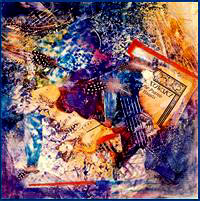
Spontaneity and discipline; illusion and reality; memory and vision, photographic image and abstraction. Contradictory? Not really. When you view the new works by Joan Furia Klutch, you'll understand. The theme of the exhibit is "Wabi Sabi," which translated from the Japanese, means "the beauty of things imperfect" Klutch inspired by her travels to the Orient and elsewhere has collaged fragments of music, photography, architecture, calligraphy, feathers, and painted landscapes onto watercolor paper in an unexpected unity of opposites. Klutch's monoprint collages are at once exciting and calming. Her experimental techniques and lavish use of color arouse the senses. Ancient music illusions, created with color, space and materials evoke both primal and contemporary. Unexpected images of parrots, geishas and sheet music punctuate several of the works, delighting the eye and mind, as the observer 'reads' the visual composition. "My mentor, many years ago, motivated me to consider the yin-yang: 'the extreme of one thing contains within it the seed of the other'" says Klutch, who feels that people have misinterpreted this to mean they should avoid extremes and instead seek an bland, temperate lifestyle. "Why would you want to set a constant balance in life and art?" she asks. "The real balance of yin and yang is the ability to go to the extreme without going over the edge." Klutch's new work is indeed edgy, but it achieves a mesmerizing balance; the 'missing pieces' of humanity, emotion and nature are combined to achieve an almost perfect visual experience. Wabi Sabi. |
|||
|
|||
|
|
|||